Blog / Small & volunteer cemeteries
Keeping Cemetery Records Safe When Volunteers and Board Members Change
Many small cemeteries run on one or two people who know where everything is. When they step back, the records do not always go with the keys. Here is how to build a handover that survives the change, and what to look for in the tools you use.
The risk is the person, not the paper
The New York Genealogical & Biographical Society's 2024 profile of the Danby Rural Cemetery board in upstate New York is a candid example. Two volunteers typed the cemetery's oldest handwritten ledgers, dating from about the 1870s, into a spreadsheet and reconciled them against later ledgers and plot maps that used different numbering systems. That spreadsheet now supports the cemetery's day-to-day tracking.
The trustees are open about what comes next. The board's president said only three of them were left who used to do that work, and a fellow trustee said it was time to try to find someone who could handle it better. The article notes the youngest trustee is 70. One volunteer also said there is no simple software package that helps rural cemeteries organise the mapping, sales and tracking of lots, and that consultants are out of reach for them.
Danby is one board's account, but the pattern is familiar. The hard part to replace is not the ledger. It is the knowledge of how the numbering works, which version is current and what the exceptions are.
What tends to go missing at handover
- The key to the numbering. Old and new plot numbering schemes sit side by side, and only one person knows how they map to each other.
- Which copy is the real one. A spreadsheet on one laptop, a printout in a binder and a ledger in a safe can each be slightly different.
- Where the originals are. Ledgers, deeds and the scanned map exist, but nobody wrote down where.
- The access. Everything runs through one person's login or one person's computer.
- The routine. The steps for a burial, a sale or a headstone request live in someone's head.
A handover kit you can build in a weekend
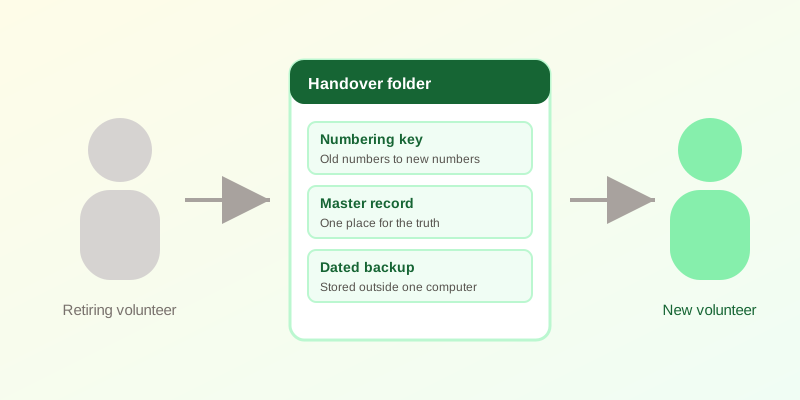
- Write the numbering key. One page explaining each numbering scheme in the records and how old numbers map to new ones.
- Name one master record. Decide where the current truth lives, and mark every other copy as a reference.
- Give each officer their own login. Avoid a shared password. When someone steps down, you remove one account instead of changing everything.
- Write the routine down. Half a page each for a burial, a plot sale and a request from a family. Plain steps are enough.
- Keep a dated backup somewhere else. At least once a year, export the records and store the copy somewhere that is not one person's computer.
- Record where the originals are. A single line per item: ledgers, deeds, scanned maps, and who holds the key.
- Have the successor shadow a real task. Walking through one burial with the person who usually does it teaches more than any document.
Choosing tools that survive turnover
- Simple enough to learn in an afternoon. A tool a new volunteer can use without a consultant is a tool that outlasts you.
- Separate logins with roles. People should be able to do their job without being able to change everything.
- A record of who changed what. When something looks wrong, an activity log turns a guess into an answer.
- A way to get your data out. If you can export your records in a standard format, you are never trapped by a tool or a person.
- Only the features you use. A long menu of options you never touch makes the next volunteer's first week harder.
How this looks in CEMETERRA
The owner can invite people as admin, staff or crew, change their role, and remove their access when they step down. Each person signs in with their own account. The cemetery keeps an activity log of key actions, including plot sales, so you can see who did what. Plots and burial records can be exported as CSV files, and the map as GeoJSON, so a dated copy can live outside the system. Sidebar sections you do not use, such as cremation or pre-need sales, can be hidden so a new volunteer sees only what matters.
The number of staff accounts depends on your plan, so check pricing before you plan who gets a login. The cemetery's owner account belongs to one person, so decide in advance who holds it and keep that in your handover notes.
CEMETERRA is built so a small or volunteer-run cemetery can map, sell and track lots without a consultant. See the full feature list or the municipal cemetery page.
If your records are still in ledgers or a spreadsheet, start with 5 signs your cemetery has outgrown spreadsheets, or create a free account and try it on your own map.